Queen Victoria Sovereigns form one of the most varied parts of the modern series. Portrait, reverse, date, mint mark, variety and condition should be considered together.
Queen Victoria Sovereigns were issued from 1838 to 1901. They followed the final William IV Sovereign of 1837 and became internationally recognised gold coins. The series includes three principal UK portraits, two major reverses and production in London, Sydney, Melbourne and Perth. It is an important part of the market for gold sovereign coins.
Queen Victoria Sovereign Specifications At A Glance
Design and mint variations do not alter the standard full Sovereign specification, although circulation wear can reduce the measured weight.
| Specification | Detail |
|---|---|
| Denomination | Full Sovereign, nominal value £1 |
| Gross Weight | Approximately 7.98g |
| Fine Gold Content | Approximately 7.322g |
| Fineness | 916.7, or 22 carat |
| Diameter | Approximately 22.05mm |
| Normal Edge | Milled |
Measurements should be checked with the edge, lettering and surfaces, not used alone.

The Three Queen Victoria Sovereign Portraits
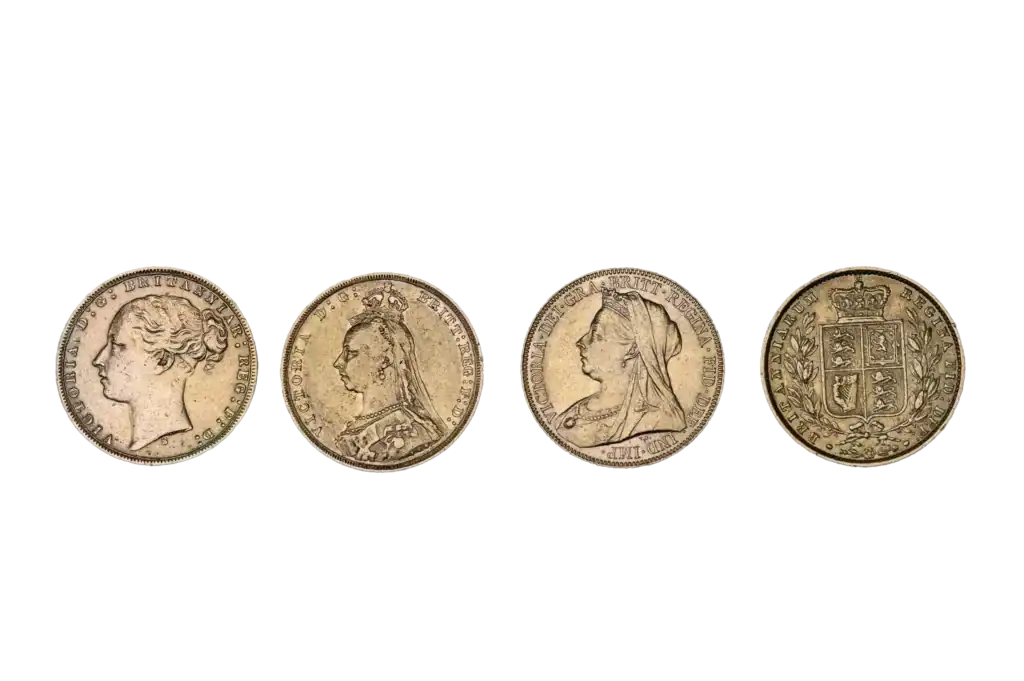
UK-struck Queen Victoria Sovereigns use three principal portraits. Transition years and branch-mint types still require careful attribution.
Young Head Sovereign
Designer: William Wyon
Broad period: 1838 to 1887
William Wyon’s Young Head Sovereign appeared from 1838. Its uncrowned portrait and tied hair distinguish it from later types.
Jubilee Head Sovereign
Designer: Joseph Edgar Boehm
Broad period: 1887 to 1893
Joseph Edgar Boehm’s Jubilee Head Sovereign arrived in 1887. Its small crown, veil and jewellery create a distinctive outline.
Old Head Or Veiled Head Sovereign
Designer: Thomas Brock
Broad period: 1893 to 1901
Thomas Brock’s Old Head Sovereign appeared in 1893. Also called the Veiled Head Sovereign, it continued through 1901.
Early Sydney exception: Early Sydney Sovereigns dated from 1855 to 1870 used separate Australian designs and portraits, so they should not be identified solely from the standard three-type comparison.

Shield Back And St George Reverse Designs
Queen Victoria Sovereigns can also be identified by reverse. Merlen’s Royal Arms shield and Pistrucci’s St George and the Dragon both appeared.
| Reverse | Design | Identification Point |
|---|---|---|
| Shield Back | Royal Arms within a wreath. | Some coins dated 1863 to 1874 carry a die number below the shield. |
| St George | St George slaying the dragon. | The date appears beneath the main scene. |
St George returned in 1871, creating an overlap with the shield. The shield was dropped from UK-struck full Sovereigns in 1875, although Australian branches continued using it until 1887.
London, Sydney, Melbourne And Perth Mint Marks
Australian branch mints converted local gold into Sovereigns. Small letters identify later issues, and our glossary explains mint marks.
| Mint | Mark | Key Note |
|---|---|---|
| London | No branch mark | Main UK production location. |
| Sydney | S | Opened in 1855; imperial-style coins with an S followed from 1871. |
| Melbourne | M | Opened in 1872. |
| Perth | P | Began Sovereign production in 1899. |
On many Young Head branch coins, the letter appears beneath the bust. On later St George issues it is commonly above the date. Early Sydney pieces instead carry a distinctive local design with Sydney Mint and Australia inscriptions.
Queen Victoria Sovereign Dates And Mintages
Queen Victoria Sovereign dates cannot be assessed by year alone because one date may have different portraits, reverses or mint marks. These examples avoid repeating the complete cornerstone tables.
| Year And Mint | Recorded Mintage | Why It Is Notable |
|---|---|---|
| 1838 London | 2,718,694 | First circulating date of the reign. |
| 1841 London | 124,054 | Lower-mintage early London issue. |
| 1855 Sydney | 502,000 | First Sydney branch year. |
| 1872 Melbourne | 748,180 | First Melbourne branch year. |
| 1879 London | 20,013 | Very low recorded London Young Head mintage. |
| 1887 London | 1,111,280 | Jubilee Head introduction year. |
| 1893 London Old Head | 6,898,260 | Final portrait introduced. |
| 1899 Perth | 690,992 | First Perth branch year. |
Recorded production does not show how many coins survive. See the complete Sovereign mintages resource for annual figures by mint.
What Makes Victorian Sovereigns Rare Or Valuable?
Mintage is only one factor. Survival, portrait, reverse, mint, die number, variety, condition, provenance and demand can all influence Queen Victoria Sovereigns. A large issue may still be scarce in high grade.
When researching Queen Victoria Sovereign value, compare the same date, mint, portrait, reverse and grade. Cleaning, repair or mounting may reduce appeal. See our guide to rare sovereigns.
Are Queen Victoria Sovereigns CGT Exempt?
HMRC currently states that Sovereigns minted in 1837 and later are sterling currency and exempt from Capital Gains Tax. As Queen Victoria Sovereigns begin in 1838, they fall within that general category under current guidance.
How To Check Authenticity And Condition
Check the expected weight, diameter and milled edge, then inspect the portrait, lettering, reverse, date and mint mark. Look for casting seams, unusual texture, inconsistent details, tooling, solder traces, rim damage and previous cleaning.
Fine, Very Fine, Extremely Fine and Uncirculated are broad descriptions. Rare or higher-value examples may benefit from independent authentication or grading.
Buying And Storing Queen Victoria Gold Sovereigns
Some Queen Victoria Sovereigns trade mainly for gold content, while scarcer dates, grades and varieties carry a larger premium. Separate metal value from collector value.
Use inert holders, avoid cleaning and retain invoices and grading records. Professional bullion storage may suit larger insured holdings.
Queen Victoria Sovereigns FAQs
What Are The Three Queen Victoria Sovereign Portraits?
They are William Wyon’s Young Head, Joseph Edgar Boehm’s Jubilee Head and Thomas Brock’s Old Head or Veiled Head.
What Is A Queen Victoria Shield Back Sovereign?
It is a Sovereign with Merlen’s Royal Arms shield reverse rather than Pistrucci’s St George and the Dragon.
Where Is The Mint Mark On A Victoria Sovereign?
It may appear beneath the bust on Young Head branch coins or above the date on later St George reverses. London coins normally have no branch letter.
Which Queen Victoria Sovereigns Are Rare?
Rarity depends on date, mint, portrait, reverse, variety and condition. The 1841 and 1879 London full Sovereigns are notable lower-mintage dates.
Are Queen Victoria Sovereigns CGT Exempt?
Under current HMRC guidance, Sovereigns minted in 1837 and later are sterling currency and exempt from CGT, although personal circumstances should be checked.
Assessing A Victorian Sovereign
Queen Victoria Sovereigns should be evaluated through portrait, reverse, date, mint and condition. For a historic Victoria Sovereign enquiry, speak to Gold Bullion Partners about identification, acquisition and secure ownership.